Implant volume and share
On a sizeable clinical implant base, the firm is going for an IPO: its product is described as among the world's smallest, lightest commercialized maglev implantable artificial hearts, approved June 2023, with three years of rising sales.
Price and the cost question
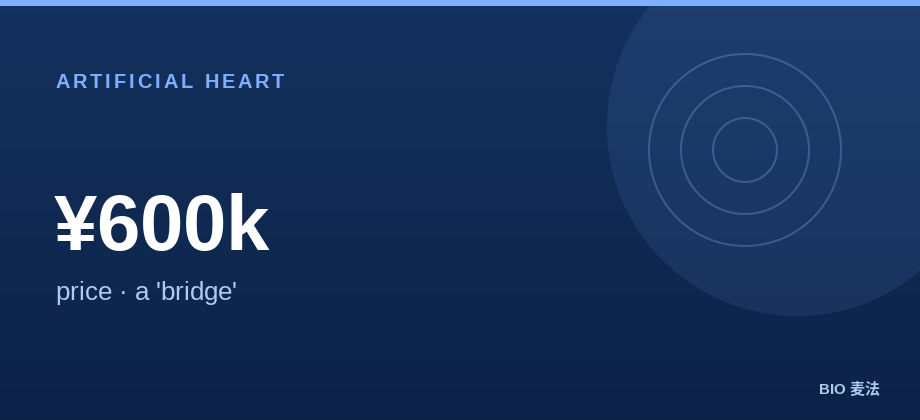
At a hospital price near RMB 600k, the market most wonders about ex-factory price, profit and affordability. High-value implant pricing must balance R&D amortization, capacity, clinical promotion and payer capacity.
Why mostly a 'bridge'
For now artificial hearts mostly serve as bridge support awaiting transplant; limited by long-term complications, donor supply and payment, 'destination therapy' still needs technology and system to keep evolving.
The BIO angle
FAQ
Why are artificial hearts so expensive?
Heavy R&D, low volume, high barriers, plus clinical and quality-system costs push the end price high (near RMB 600k at hospitals).
Why are they mostly a 'bridge'?
They mostly serve as bridge support awaiting transplant; as 'destination therapy' they still evolve, limited by complications, donors and payment.
What does fast sales growth mean?
Rising clinical acceptance and capacity ramp — but with high price and low base, profitability still needs scale.
Related reading
- Carmat Aeson Total Artificial Heart: Design and Materials of the EU's Only Commercial TAH | BIO Insights
- Percutaneous RVAD Enters the Fast Track: the Overlooked Right Heart and a Materials Barrier | BIO Insights
- China's Maglev Artificial Heart: from First Implant to the Global High-End Market | BIO Insights
Note: an original analysis compiled from public industry information; figures and conclusions per official/original sources. Not investment advice.
Building in China's medical-device market?
From NuSil™ medical-grade silicone screening to current TDS/SDS coordination, development samples, and lot-traceable supply in China, share your device requirements directly with our Shanghai team.